Software plays an integral role in everyday life due to its near-ubiquitous presence in an increasingly technological society. It has a profound impact on improving the efficiency, reliability, security, and safety of numerous service-oriented and mission-critical systems.
These goals, however, cannot be fully achieved without proper software testing. While many courses aim to equip students with fundamental knowledge and techniques in software testing, they often overlook industry practices and provide limited real-world testing experience. To address this gap and to promote advanced software testing theories, techniques, and tools, the Technical Committee on System and Software Assurance of the IEEE Reliability Society and the Dallas Chapter of the IEEE Reliability Society, in collaboration with the Computer Science Department at the University of Texas at Dallas, along with other sponsors such as Mooctest Inc., have organized multiple IEEE International Contests on Software Testing at various venues in recent years.
The contest aims to provide participants with hands-on, real-world software testing and tool-usage experience, offering valuable opportunities to apply their learned testing techniques to address industry-level testing challenges.
The upcoming contest will be held on Saturday, April 11, in a hybrid format, with both in-person sessions at ECSS 2.102 (TI auditorium) and ECSS 2.410 on the University of Texas at Dallas campus, as well as online participation.
Although participation in the contest is free of charge, all contestants are required to complete their registration on the contest website by April 10.
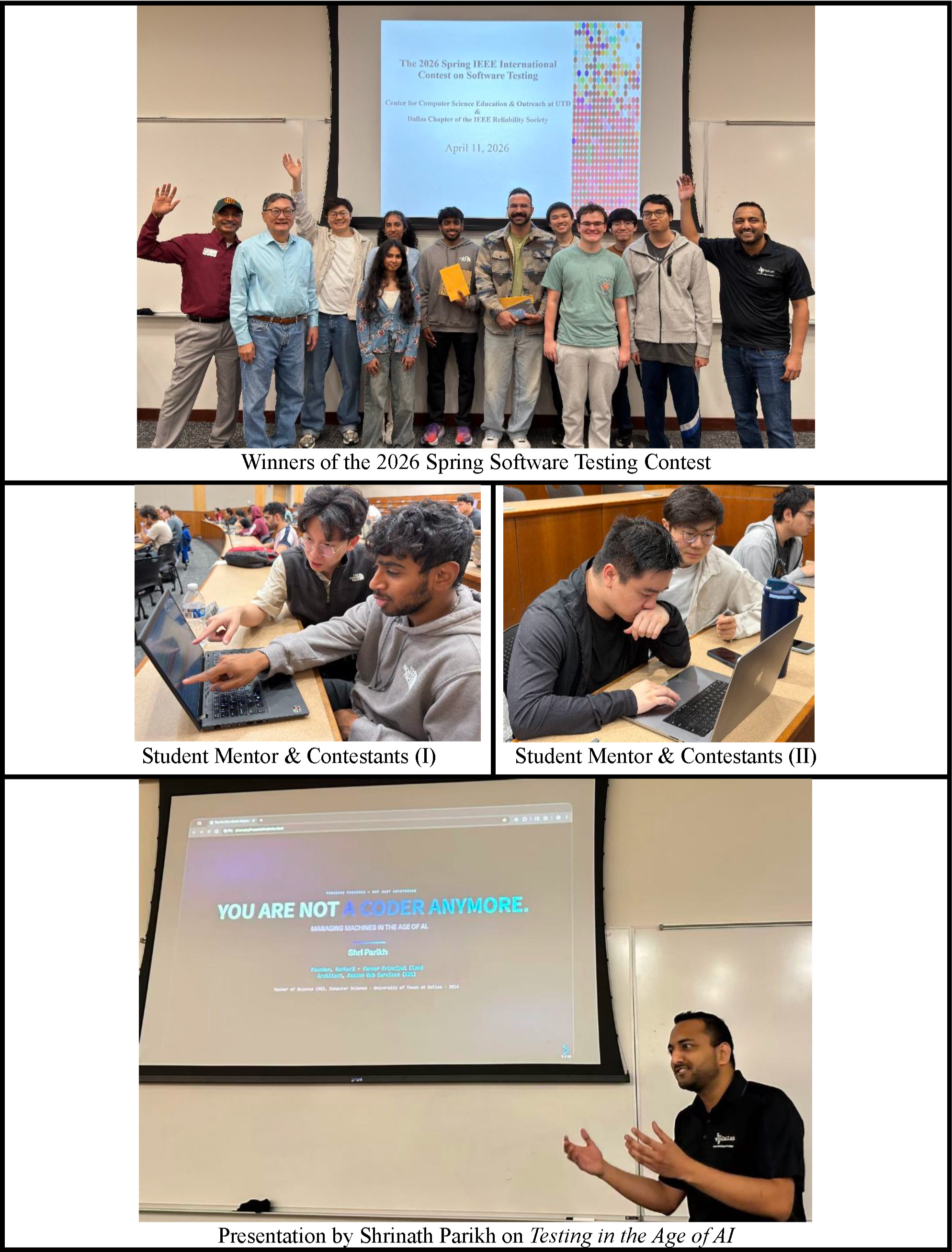
Each contestant received a certificate of participation for attending the contest.
The top ten contestants also received cash prizes and equivalent gifts.
| 1st Place | Rishi Villa | $200 Cash & Wireless VoIP Headset ($100) |
| 2nd Place | Sina Moghtased | $100 Cash & Bluetooth Speaker ($100) |
| 3rd Place | Omar Le Khan | $60 Cash & Bluetooth Speaker ($100) |
| 4th Place | Chayanin Noramuttha | Bluetooth Speaker ($100) |
| 5th Place | Arshia | Bluetooth Speaker ($100) |
| 6th Place | Tejashree Reddi | Wireless Earbuds ($50) |
| 7th Place | Steven Duong | Wireless Earbuds ($50) |
| 8th Place | Mashiat Amin Farin | Wireless Earbuds ($50) |
| 9th Place | Oluwawemimo Joyce Jayeoba | Wireless Earbuds ($50) |
| 10th Place | Ronald Caleb Smitheart | Wireless Earbuds ($50) |
All contestants must use their own computers with the required software installed (see Running Environment). The contest consists of two parts:
The first part consists of a JUnit tutorial and practice, which will be available from March 1 to April 10. Each contestant may complete this part independently. The objective is to help participants become familiar with the contest format and the fundamentals of the JUnit testing framework. Basic knowledge of Java programming is required.
The second part will take place on April 11, 2026, from 9:00 AM to 12:00 PM (CDT). The contest is individual-based. Each contestant will design test cases with specific input values based on the provided README file and source code to test multiple Java programs. The quality of the generated test cases will be evaluated based on the achieved code coverage and mutation scores.
Operating System Requirements
The system must run on Windows 10 or later, or macOS.
IDE Configuration
Any Integrated Development Environment (IDE) compatible with JDK 8 is supported, including but not limited to Eclipse and IntelliJ IDEA.
Environment Configuration
Participants may choose to configure JDK 8 and Maven 3 locally or utilize the virtual environment built into their IDE.
Local Configuration
Please download JDK 8
and Maven 3.
Installation should follow the provided tutorials for JDK 8
and Maven 3.
Using IDE-Bundled JDK 8 and Maven 3
Alternatively, users may directly utilize the JDK 8 and Maven 3 bundled with their IDE. For reference, please consult the tutorial for
IntelliJ IDEA.
All the contestants should watch the video via YouTube and complete a practice test at http://www.mooctest.net/login to get familiar with the Mooctest platform before participating in the contest.
☞ Click here to watch the tutorial on YouTube.
The in-person contest will be held in ECSS 2.102 (TI Auditorium) and ECSS 2.410 on the University of Texas at Dallas campus. Online participants can join via Zoom using the following credentials (Meeting ID: 878 9935 6950; Passcode: 330233)